

Every new operator eventually arrives at the same question, usually after spending an afternoon reading conflicting information online: which licence do I actually need?
The honest answer is that it depends — but not in the vague, non-committal way that phrase usually implies. It depends on specific, knowable things: your target market, your budget, your timeline, your appetite for compliance overhead, and where you plan to be in two to three years. Match those variables to the right jurisdiction and the answer becomes fairly clear. Get it wrong and you are either overpaying for credibility you do not need yet, or underinvesting in a regulatory position that will limit your payment options and player trust when you need them most.
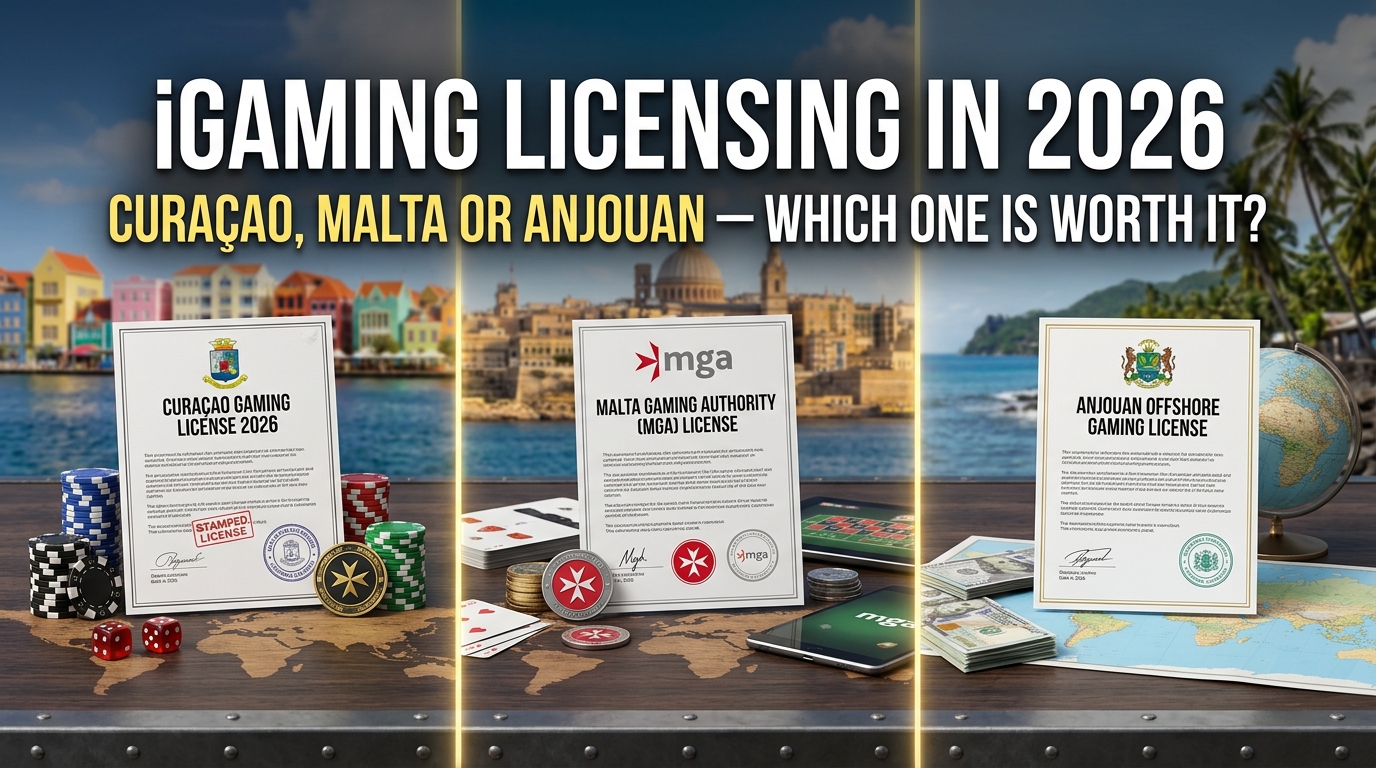
This is a comparison of the three jurisdictions that new operators ask about most in 2026: Malta, Curaçao, and Anjouan. All three have changed significantly in the past 12 to 18 months. The landscape looks meaningfully different from what it was in 2024, and some of the conventional wisdom about these jurisdictions is now outdated.
Malta (MGA): The Premium Option
The Malta Gaming Authority is the most recognised iGaming licence in the world outside of the UK. It carries genuine weight with payment processors, banking partners, and players in regulated European markets. If your long-term ambition is to operate a serious, mainstream platform serving European player bases, the MGA is eventually the right direction.
The cost reflects this. Application and annual fees sit between $25,000 and $50,000, with a 5% gaming tax applied on GGR from players in Malta and most EU markets. But the headline fee is only part of the picture. The real cost of an MGA licence includes a registered business entity in Malta, key function holders who pass fit-and-proper checks, detailed compliance infrastructure covering KYC, AML, and responsible gambling tooling, and ongoing audit obligations. Independent analysis puts realistic Year 1 costs — including compliance staffing, legal fees, and operational setup — anywhere between €130,000 for a lean mid-tier operation and considerably more for an operator with ambitions to serve multiple EU markets at scale.
The timeline is another consideration. MGA applications are thorough and the review process reflects that. Operators typically budget six months minimum from application to licence grant, and that assumes clean documentation and no requests for additional information. For operators who need to be live quickly, this creates a structural problem.
Who Malta is actually right for: Operators who are already past the startup phase, have confirmed revenue from an existing operation, are specifically targeting regulated European markets, and have the capital to absorb both the licence cost and the compliance infrastructure it demands. If your target market is Southeast Asia and you are building your first platform, the MGA is almost certainly not the right starting point. It is a destination licence, not a launch licence.
Curaçao: The Established Middle Ground — Now Significantly Changed
Curaçao was, for a long time, the default choice for operators who wanted a credible offshore licence without the MGA’s cost or timeline. An established jurisdiction, internationally recognised by most payment processors, with a relatively fast approval process and a 0% gaming tax on international revenue. That version of Curaçao still exists in the memory of the industry. The current version is different.
From 1 January 2026, real physical presence on the island is mandatory under the new LOK (Landsbesluit Online Kansspelen) framework. Not a registered address — an actual office, staff, and a managing director who genuinely runs the business from Curaçao. This is not a line item in a budget. It is a separate operational project that takes two to three months to establish and has to be completed before the application goes in. Local staffing requirements are scheduled to expand further in 2027 and 2029.
The cost has shifted accordingly. Official fees are approximately €47,450 per year — compared to roughly €17,000 for Anjouan. Add the physical presence requirement, and the real cost of a Curaçao licence in 2026 is considerably higher than the official fee suggests. Office rent, local salaries, infrastructure, and the non-refundable application fee make the three-year total cost of ownership substantially higher than most operators planning a Curaçao application currently have budgeted.
The jurisdiction also had a turbulent period at board level through 2025. Treat its regulatory stability as a live question rather than an established fact.
Who Curaçao is actually right for: Operators at a mature stage who specifically need Curaçao’s payment processing acceptance — which remains broader than Anjouan’s in certain markets — and who have the operational capacity to establish genuine physical presence on the island. For early-stage operators, the cost and presence requirements make it difficult to justify over Anjouan unless there is a specific payment processing reason that Anjouan cannot satisfy.
Anjouan: The Fast, Low-Cost Option That Has Gotten More Serious
Anjouan — issued by the Anjouan Gaming Authority under the Union of Comoros — has historically been the budget option. Fast, cheap, minimal requirements. That characterisation is still broadly accurate on cost and speed, but Anjouan has tightened its procedures considerably over the past 18 months and is no longer quite the rubber-stamp jurisdiction it was sometimes portrayed as.
The numbers make the appeal obvious. Official fees sit at approximately €17,828 per year, renewable annually at the same rate. Application processing takes two to four weeks — sometimes as fast as 28 to 42 business days under current procedures. There is no requirement for a local company, office, staff, or resident director. For a new operator trying to get live quickly without absorbing six months and six figures in licensing overhead, these numbers are difficult to argue with.
Recent procedural updates have added genuine compliance requirements. Operators must now appoint an Alternative Dispute Resolution provider. B2B recognition certificates for service providers have been introduced. Quarterly reporting has been added. These are steps toward a more credible regulatory framework rather than cosmetic changes, and they matter — not because they add significant cost, but because they move Anjouan away from the perception that it exists purely to generate licence fee revenue with no genuine oversight.
The limitation that matters most for operators evaluating Anjouan is payment processing. Some payment processors and banking partners treat Anjouan-licensed operators with more friction than Curaçao or MGA operators. For operators building platforms with crypto payment infrastructure — where blockchain-based transactions bypass traditional payment processors entirely — this limitation is largely irrelevant. For operators dependent on card processing and traditional banking relationships, it is a real constraint worth investigating before committing.
Who Anjouan is actually right for: New operators launching their first platform, operators targeting markets where the Anjouan licence is accepted by their payment stack, and crypto-native operators for whom traditional payment processor acceptance is not the primary concern. For anyone using a crypto-first platform like Superbit, Anjouan’s payment processor friction is largely a non-issue — and the cost and speed advantages are unambiguous.
The Costs Side by Side
Numbers shift, and the specific figures below should be verified before filing an application. But as of mid-2026, the approximate landscape looks like this:
Anjouan: ~€17,828/year official fee. No local presence required. Two to four week approval. Total Year 1 cost (including compliance setup) roughly €80,000–€130,000 for a lean operation.
Curaçao: ~€47,450/year official fee. Physical presence on the island mandatory from January 2026. Three to six month approval. Total Year 1 cost considerably higher once office, staffing, and operational setup are included.
Malta (MGA): $25,000–$50,000 annual fee plus 5% gaming tax on EU GGR. Registered entity and key function holders in Malta required. Six months minimum approval timeline. Total Year 1 cost €130,000–€225,000 for a mid-tier operation, higher for operators targeting multiple EU markets at scale.
The headline licensing fee, as one analysis noted, represents only 15–25% of total licensing-related costs in Year 1. Compliance staffing, KYC and AML infrastructure, legal fees, responsible gambling tooling, and audit costs are the hidden majority. Any operator budgeting only for the licence fee is significantly underestimating what the first year actually costs.
The White Label Option
There is a fourth path worth mentioning, particularly for operators who want to get live quickly without immediately committing to a licensing application.
In a white label arrangement, the platform provider holds the licence and the operator runs under it. This is the fastest path to market — it removes the licensing application process entirely — and it is the most common approach for first-time operators building their initial player base before investing in their own licence.
The trade-off is dependency. Your ability to operate is tied to your provider’s licence standing. If the provider’s licence is challenged or their compliance position deteriorates, you are affected. For operators who eventually want full independence, building toward their own licence is the right long-term plan. For operators who want to learn the market before committing that capital, the white label route under a provider’s existing licence makes practical sense.
TT Wonders’ white label solutions operate under established licensing arrangements, allowing operators to launch and build their platform while developing the operational track record that supports a future standalone licence application.
What Actually Decides It
Strip away the details and the decision matrix for most operators in 2026 looks like this:
If you are a new operator launching your first platform, targeting Southeast Asian markets, and building on crypto infrastructure — Anjouan is the correct starting point. The cost and speed advantages are real, the compliance requirements are manageable, and the payment processor limitation is minimal if your stack does not depend on traditional card processing.
If you are an established operator with proven revenue, targeting European regulated markets, and building toward a long-term mainstream brand — Malta is the destination. Get there when you are ready for it, not before.
If you are somewhere in between — established enough to absorb cost and operational overhead, but not yet ready for MGA compliance demands — Curaçao remains an option, but the 2026 presence requirements have made it considerably less accessible than it was. Run the real cost of ownership before assuming it is the obvious middle ground.
And if none of the above fully applies — if you want to test a market, build an initial player base, and defer the licensing decision — a white label platform under an existing provider licence is the lowest-friction entry point.
The licence is not the business. It is the legal permission to run one. Choose the permission that fits where you actually are, not where you plan to be in five years.
Recommended
 Gaming Licenses Explained: Types, Requirements, and Costs for Online Casinos
Gaming Licenses Explained: Types, Requirements, and Costs for Online Casinos
 Why Your Welcome Bonus Is Attracting the Wrong Players
Why Your Welcome Bonus Is Attracting the Wrong Players
 Best Casino Platforms for High Conversion Rates


