

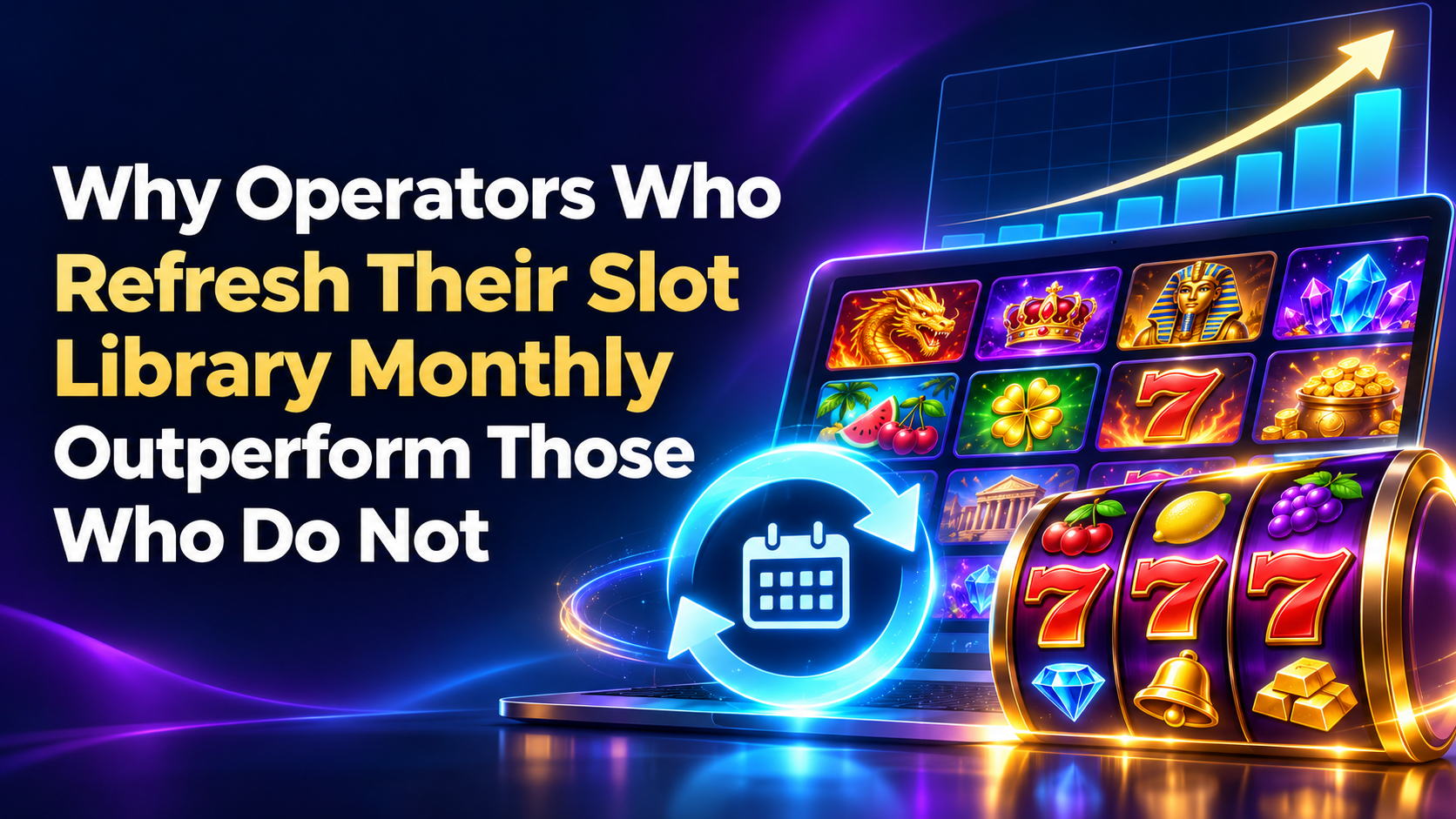
There is a version of slot library management that looks like a strategy but is not. The operator integrates a set of game providers at launch, populates the lobby with a few hundred titles, and then leaves it largely untouched. New games trickle in occasionally — when a provider pushes an update or when a player asks why a specific title is not available. The lobby is never obviously broken. It just quietly stops being competitive.
The operators building the strongest slot performance in 2026 are running a different process. They are evaluating new releases monthly, rotating featured content deliberately, retiring underperforming titles, and treating their game library as a live product rather than a completed build. The performance difference between these two approaches is not marginal. It compounds over time in ways that show up clearly in session depth, return visit rates, and GGR per active player.
Understanding why requires looking at what a static slot library actually does to a player base over time — and what a regularly refreshed one does instead.
What Happens to a Static Library
A player who joins a platform and spends their first month exploring the slot lobby is in a discovery phase. They try different titles, find a few they like, bookmark their favourites. This is the most valuable player behaviour an operator can cultivate — it builds multiple points of attachment to the platform and creates the habit of coming back to explore rather than just to play one familiar title.
At some point, discovery ends. The player has seen everything in the lobby that interests them. They know which titles they like and which they do not. From this point, their session behaviour changes: they arrive, go directly to their favourites, play for a while, and leave. The platform has become a vehicle for a specific habit rather than a destination in itself.
This is not catastrophic. Regular players with established habits generate consistent GGR. But it creates two risks that compound over time.
The first is churn vulnerability. A player whose entire relationship with a platform is built around three or four specific slot titles is one bad session away from trying a competitor. If those same titles are available elsewhere — which they almost certainly are — there is no lobby-specific reason for them to come back to this particular platform.
The second is acquisition weakness. Word-of-mouth and community recommendation in online gambling is heavily influenced by what is new and interesting on a platform right now. A lobby that looks the same as it did six months ago generates no new conversation. A lobby that has just added a highly anticipated release generates exactly the kind of player-to-player referral that no marketing budget can replicate.
Both risks compound quietly for months before they show up as numbers a finance team flags. By then, recovering from a stale lobby is considerably harder than it would have been to maintain a fresh one.
What New Releases Actually Do for a Player Base
The iGaming industry releases new slot titles at a volume that most operators outside the industry find surprising. Major studios — and the tier-two providers whose output is increasingly competitive — are releasing multiple new titles per month. Annual release volumes across the full market run into the thousands.
Most of these titles will not sustain long-term engagement. That is the nature of any content market. But the titles that do break through — that generate player community buzz, streaming coverage, forum discussion, and the specific kind of social proof that drives trial — tend to do so in their first two to four weeks of availability.
An operator whose library refresh cycle runs quarterly is, at best, featuring those titles six weeks after the peak window of player interest has passed. At worst, they are adding them when player community attention has already moved on to the next release. The first-mover advantage in slot content is real and time-sensitive.
The operators who add genuinely anticipated releases during their peak window — within the first week or two of market availability — capture the player acquisition and engagement lift that those titles generate. This is not about adding every new release indiscriminately. It is about having a process that identifies high-potential titles early and gets them live quickly. A platform built on TT Wonders’ aggregator API with seamless provider integrations makes this operationally realistic — adding a new title from an already-integrated provider is a configuration decision, not a technical project.
The Lobby Design Dimension
New releases are one input. How they are surfaced in the lobby is what actually determines whether players discover them.
A “New Games” section is the standard approach, and it works well enough as a baseline. But operators who are seeing the strongest results from their content refresh strategy are going further. Featured game placements on the lobby homepage rotate on a weekly cycle, ensuring that a returning player who visits three times in a week sees something different each time they land. Email and push notifications to relevant player segments — players who have engaged with similar titles, or players who were active on the previous release from the same studio — drive targeted first-session plays on new content.
This is lobby management as an editorial function rather than a technical one. It requires someone looking at what is new, deciding what to feature, understanding which player segments are most likely to respond, and communicating to those segments at the right moment. Platforms with attractive, customisable front-end design that can update featured content without a development cycle make this process practical for operators running lean teams. Platforms where every lobby change requires a technical ticket do not.
Retiring Underperformers Is as Important as Adding New Content
The other side of library management that operators consistently undervalue is removal.
A slot lobby with 2,000 titles where 400 of them have generated zero sessions in the past 90 days is not a library with great selection. It is a discovery problem. Players who open the lobby and encounter a wall of unfamiliar titles with no obvious hierarchy or curation signal will default to the search function or rely on their existing favourites. The breadth of the catalogue is invisible to them because there is no practical way to navigate it.
Removing consistently underperforming titles — or moving them to a dedicated archive section rather than the main lobby — does several things simultaneously. It makes the active lobby more navigable. It improves the signal-to-noise ratio in category sections, so players browsing “New Slots” or “Popular” are seeing titles that actually have engagement behind them. And it forces a useful internal conversation about why certain titles are not performing — which sometimes reveals issues with lobby positioning or bonus eligibility rather than the titles themselves.
Understanding the volatility profile of every title in the library is relevant here. Some titles underperform not because the game is weak but because their volatility profile is mismatched to the primary player segment of the lobby they are sitting in. A high-volatility title buried in a general slot section where the player base skews recreational will consistently underperform — not because the title is bad, but because it is in the wrong position for the players who are actually browsing there.
Provider Relationships and the Release Pipeline
Operators who refresh their slot library effectively tend to have a different kind of relationship with their game providers than those who treat content as a one-time integration.
Active provider relationships give operators advance visibility on upcoming releases — roadmaps, preview builds, release dates. This intelligence is what makes a first-week launch window achievable rather than aspirational. An operator who hears about a major release on the same day it goes public cannot feature it during the peak window. An operator who knew about it three weeks in advance has had time to prepare the featured placement, draft the player communication, and configure any promotional mechanics around the launch.
Providers like Nextspin make this kind of advance visibility accessible to operator partners through their documentation and release process — giving operators the information they need to plan content launches rather than react to them. The broader provider ecosystem on the TT Wonders platform is structured around exactly this kind of active partnership model rather than a passive content feed.
The Data Layer
None of this is guesswork if the data infrastructure supports it. The operators running the most effective slot library refresh processes are doing so with clear performance metrics: sessions per title in the past 30 days, GGR per active player by title, average session length by game category, and new-to-returning player ratio for recently added titles.
These metrics answer the specific questions a monthly refresh process requires: Which titles are genuinely engaging the player base? Which are underperforming relative to their lobby position? Which newly added titles are attracting new players versus being picked up by existing ones? Which categories are seeing declining engagement that might signal a need for new content?
A platform with robust reporting — including speedy setup and performance tracking infrastructure — surfaces these metrics without requiring the operator to build custom analytics pipelines. For operators who are making content decisions based on intuition rather than session data, the first step toward a meaningful library refresh process is getting the data infrastructure right.
The Competitive Framing
Here is the simplest version of why this matters: the operators a player might consider switching to are refreshing their lobbies. New releases appear on competing platforms. Players in gambling communities talk about what they are playing and where. When a title that was discussed heavily in the communities a player follows is not available on their current platform, that absence registers. Not necessarily as a reason to switch immediately, but as a data point that accumulates over time.
A monthly refresh cycle is not about chasing every trend. It is about maintaining the baseline expectation that a serious operator’s library reflects what is currently happening in the game market. Falling more than two or three months behind that baseline creates a perception gap — a sense that the platform is not fully invested in its slot product — that affects player trust in ways that are difficult to measure but easy for players to articulate when asked why they chose a competitor.
The slot features and mechanics that drive retention are ultimately delivered by the specific titles in the library. An operator cannot access the best mechanics in the market if the titles that embody them are not in the lobby. Regular refresh is not a content strategy in isolation — it is the prerequisite for every other slot retention strategy working as intended.
What a Monthly Process Actually Looks Like
For operators who want to move from an ad-hoc refresh model to a structured monthly one, the operational requirements are not onerous.
A monthly content review cycle involves: pulling performance data on the existing library, reviewing the release calendars of integrated providers for the coming month, identifying high-potential new titles for early addition, confirming lobby positioning and featured placement for launches, flagging underperforming titles for review or removal, and planning player communications around significant new releases.
This is a few hours of focused work monthly, not a full-time role. The platforms that make it hard — where adding a title requires a technical ticket, where lobby changes cannot be made without a developer, where performance data requires manual extraction — are the ones where the refresh process atrophies because it costs too much friction. The iGaming platform templates and infrastructure at TT Wonders are built specifically to reduce this friction — putting lobby management, featured content rotation, and provider integration in the hands of the operator rather than in a development queue.
The difference between an operator who does this monthly and one who does not is not visible after three months. It is very visible after twelve.
Recommended
 The Pros and Cons of White Label iGaming Solutions
 Why Your Welcome Bonus Is Attracting the Wrong Players
 White Label Casino Solutions: Unlocking the Benefits and Opportunities


