

If you are planning to launch an online casino in 2026, one of the first decisions you will face is also one of the most consequential: do you build on fiat infrastructure, crypto infrastructure, or some combination of both?
The internet has no shortage of opinions on this. Crypto evangelists will tell you fiat casinos are obsolete. Traditional operators will tell you crypto is too niche to anchor a business around. Neither of these is a particularly useful starting point for someone who needs to make an actual decision.
What follows is a straight comparison — what each model requires, what it costs, what it offers players, and where each one makes sense. The goal is not to declare a winner. It is to give you enough clarity to make the right call for your specific market and operator profile.
The Fundamental Difference
Both models are online casinos. Players register, deposit, play games, and withdraw. The product experience on the surface can look nearly identical. The difference is in the payment layer — and the payment layer shapes almost everything else.
A fiat casino processes payments in national currencies through traditional financial infrastructure: banks, card schemes, payment processors, e-wallets. This infrastructure is mature, widely understood, and the default expectation for most players globally. It also comes with the full weight of that infrastructure’s requirements: banking relationships, merchant account approvals, compliance obligations tied to regulated payment processors, and the settlement timelines built into legacy financial systems.
A crypto casino processes payments through blockchain networks. Deposits and withdrawals move in Bitcoin, Ethereum, USDT, or other supported assets. There are no banks in the middle, no payment processor approvals required, no card scheme rules to navigate. The payment infrastructure is open by design, which changes the operator’s relationship with payments fundamentally — and changes the player experience in ways that matter for retention.
Starting Up: What Each Model Actually Costs to Launch
This is usually the first practical question for a new operator, and the answer is more nuanced than headline figures suggest.
Fiat casino launch costs are front-loaded with relationship-building. Before you process a single player deposit, you need a gaming licence (typically $15,000–$30,000 and upward depending on jurisdiction), a merchant account with a payment processor willing to onboard a gambling business (increasingly difficult in many markets), and banking relationships that support gambling transactions. Many operators underestimate how long this takes. Payment processor approvals for gambling merchants can take months. Some jurisdictions effectively close this door entirely for new entrants without existing relationships.
The platform build itself — software, game integrations, back office — is a separate cost that sits on top of these regulatory and payment requirements.
Crypto casino launch costs remove most of the payment infrastructure overhead. There is no merchant account to apply for. No payment processor to approve you. No banking relationship to establish for the core payment rails. The blockchain infrastructure is permissionless — you integrate it, you use it, you pay network fees per transaction rather than processor margin per deposit.
This shifts the cost structure considerably. More of the budget goes toward platform, game content, and marketing. Less disappears into regulatory payment compliance before a single player has been acquired.
For new operators evaluating options, TT Wonders’ Superbit platform is built specifically around this crypto-first cost structure — the payment infrastructure, wallet management, and blockchain integration are pre-built and included, reducing the technical overhead of launch to configuration and brand setup rather than infrastructure development.
Player Base: Who You Are Actually Trying to Reach
The most important factor in choosing between models is not technology preference — it is who your target players are and how they want to transact.
Fiat casino players represent the broader recreational gambling market. They are comfortable with bank transfers, debit cards, and e-wallets. They may have no opinion about cryptocurrency and no interest in acquiring any. In Western markets, in regulated jurisdictions where gambling advertising is mainstream, and among older demographic segments, fiat remains the default expectation. A crypto-only offering in these markets creates unnecessary friction for a player base that does not want it.
Crypto casino players are a distinct and growing segment. They hold digital assets, understand how wallets work, and often actively prefer crypto transactions for the speed, privacy, and permissionless access they provide. This segment skews younger, skews tech-aware, and is disproportionately represented in markets where traditional banking is either inaccessible, slow, or carries stigma for gambling transactions. Southeast Asia, Latin America, and parts of Eastern Europe show particularly strong crypto casino adoption patterns — precisely because in these markets, the friction of fiat casino payments is not just inconvenient, it is a genuine barrier.
For operators targeting Southeast Asian markets specifically — where players are mobile-first, crypto adoption is accelerating, and banking infrastructure for gambling merchants is restrictive — the crypto model is not a niche alternative. It is often the more accessible path to a viable player base.
Regulation and Compliance: The Honest Picture
Neither model is a regulatory free pass. Both require careful navigation. But they navigate different terrain.
Fiat casino compliance is primarily driven by payment processor requirements and banking relationships. KYC and AML obligations exist for both models, but fiat casinos often face more demanding identity verification requirements upfront — partly because payment processors require them as a condition of the merchant relationship, and partly because card scheme rules demand it. This can create registration friction that fiat casinos struggle to reduce without risking their payment relationships.
Crypto casino compliance is evolving. The regulatory landscape for crypto gambling is less settled than for fiat, which creates both opportunity and uncertainty. Jurisdictions like Curaçao have developed licensing frameworks that cover crypto operations. Others are still working through it. The absence of a banking intermediary removes some compliance layers but does not remove the underlying obligation to operate a responsible gambling environment with appropriate player protections.
The honest summary: fiat casinos operate in a more established regulatory environment with clearer rules and more established compliance infrastructure. Crypto casinos operate in a faster-moving environment with more flexibility but also more uncertainty. Neither is inherently safer from a compliance standpoint — they require different expertise.
Player Experience: Where the Differences Are Most Visible
This is where the two models diverge most sharply, and where the right choice becomes clearest.
Deposits on a fiat casino involve a player entering card details or logging into an e-wallet, triggering a processor authorisation, and waiting for confirmation — typically seconds to a few minutes, but subject to bank-side delays, declined cards, and processor outages. On a crypto casino, a deposit is a wallet-to-wallet transaction that is confirmed on the blockchain in minutes. No card details shared. No processor intermediary. No decline reason codes.
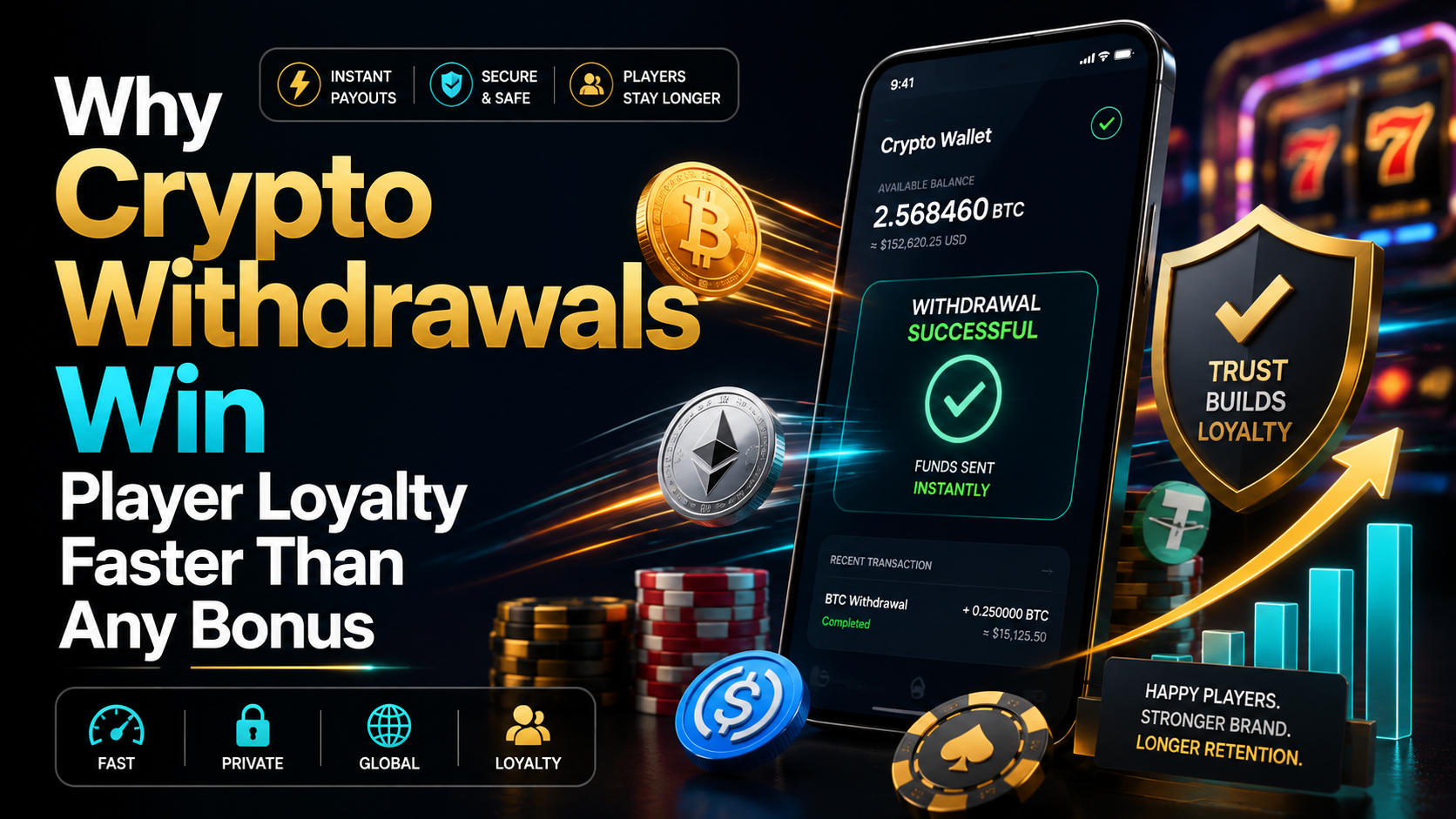
Withdrawals are where the difference becomes a loyalty issue. Fiat withdrawals — as covered in detail in our piece on why crypto withdrawals drive loyalty faster than bonuses — run through settlement infrastructure that is structurally slow. Two to five business days for a bank transfer is not unusual. Crypto withdrawals on a properly built platform process in minutes. This is not a marginal improvement. For a player who has just won a meaningful amount and wants their money, the difference between five minutes and five days is the difference between a platform they trust and one they are suspicious of.
Anonymity and access matter in markets where banking stigma around gambling is real. A player who does not want their bank statement to show a casino transaction has a genuine reason to prefer crypto. This is not about illicit activity — it is about the social and practical reality of gambling in markets where it carries stigma even when it is not regulated against. Crypto casinos serve this need without requiring the operator to do anything special.
The Hybrid Approach: Both Models Together
The most commercially pragmatic answer for many operators is not either/or. It is building a platform that handles both fiat and crypto, serving different player segments through the same lobby.
This is the direction the industry is moving. Players who want to deposit by card can do so. Players who want to deposit in USDT can do that too. The same game library, the same back office, two payment rails serving different preferences.
The challenge is execution. Adding crypto payment capability to a fiat-first platform as an afterthought produces a second-class crypto experience — slower processing, fewer supported assets, less reliable automation. Adding fiat payment capability to a crypto-native platform requires establishing the merchant relationships and compliance infrastructure that crypto was supposed to avoid.
The cleanest hybrid implementations start with a platform architecture that can support both models natively, rather than trying to retrofit one onto the other. Superbit is built crypto-native, and TT Wonders’ broader platform supports multi-currency operations — meaning operators can launch crypto-first and expand to include fiat payment options as their market and regulatory situation develops, without rebuilding the platform from scratch.
Which One Is Right for You
No honest comparison ends with a universal recommendation, because the right answer genuinely depends on who you are trying to serve.
If your target market is a regulated Western jurisdiction with mainstream player demographics, strong banking infrastructure, and a player base that has no particular interest in crypto — a fiat-first platform is probably the right starting point. Crypto can come later as the market develops.
If your target market is Southeast Asia, or any market where banking access for gambling is restricted, payment infrastructure is slow or unreliable, and your target player demographic is younger and crypto-aware — a crypto-first platform will likely outperform. The lower launch friction, faster payment experience, and natural fit with your player segment’s preferences are structural advantages that compound over time.
If you are genuinely uncertain, or targeting a market with mixed player demographics — start with the back office and platform capabilities that can support both, build on crypto infrastructure for the payment speed advantages, and layer in fiat capability when the market demand and regulatory pathway are clear.
The worst outcome is choosing a model based on what is easiest to explain rather than what actually fits your market. Both models can build profitable businesses. The one that fits your players’ payment preferences and your market’s regulatory reality will always outperform the one that does not.
The Bottom Line
Crypto casinos are not a replacement for fiat casinos. Fiat casinos are not a dying format. Both serve real players with real preferences, and the market is large enough for both.
What has changed is the expectation bar. Players who have experienced instant crypto withdrawals do not go back to waiting three days without noticing. Markets where crypto adoption has reached a tipping point are not going to reverse. And the technical barrier to launching a crypto casino — which was genuinely high before platforms like Superbit reduced it — is no longer the obstacle it once was.
For new operators entering the market today, the question is not whether crypto matters. It is whether it matters more than fiat for the specific players you are trying to reach. Answer that question honestly, and the rest of the decision follows.
Recommended
 Everything You Need to Know About White Label Online Casinos
Everything You Need to Know About White Label Online Casinos
 Play Big in India with TT Wonders: Cricket-Centric Gaming and Exclusive Merchant Offers
Play Big in India with TT Wonders: Cricket-Centric Gaming and Exclusive Merchant Offers
 Enhance Gaming with TruePay and FPX: Enjoy Special Promo Rates on Deposits


