

Most industries have a version of the white label model. The supermarket’s own-brand cereal is made by the same factory as the name-brand one on the shelf next to it. The printer your office uses was assembled by a manufacturer you have never heard of and rebranded by the company whose logo is on the lid. The product is real. The brand on top of it is the part that changes.
Online casinos work the same way — and have done for longer than most people outside the industry realise.
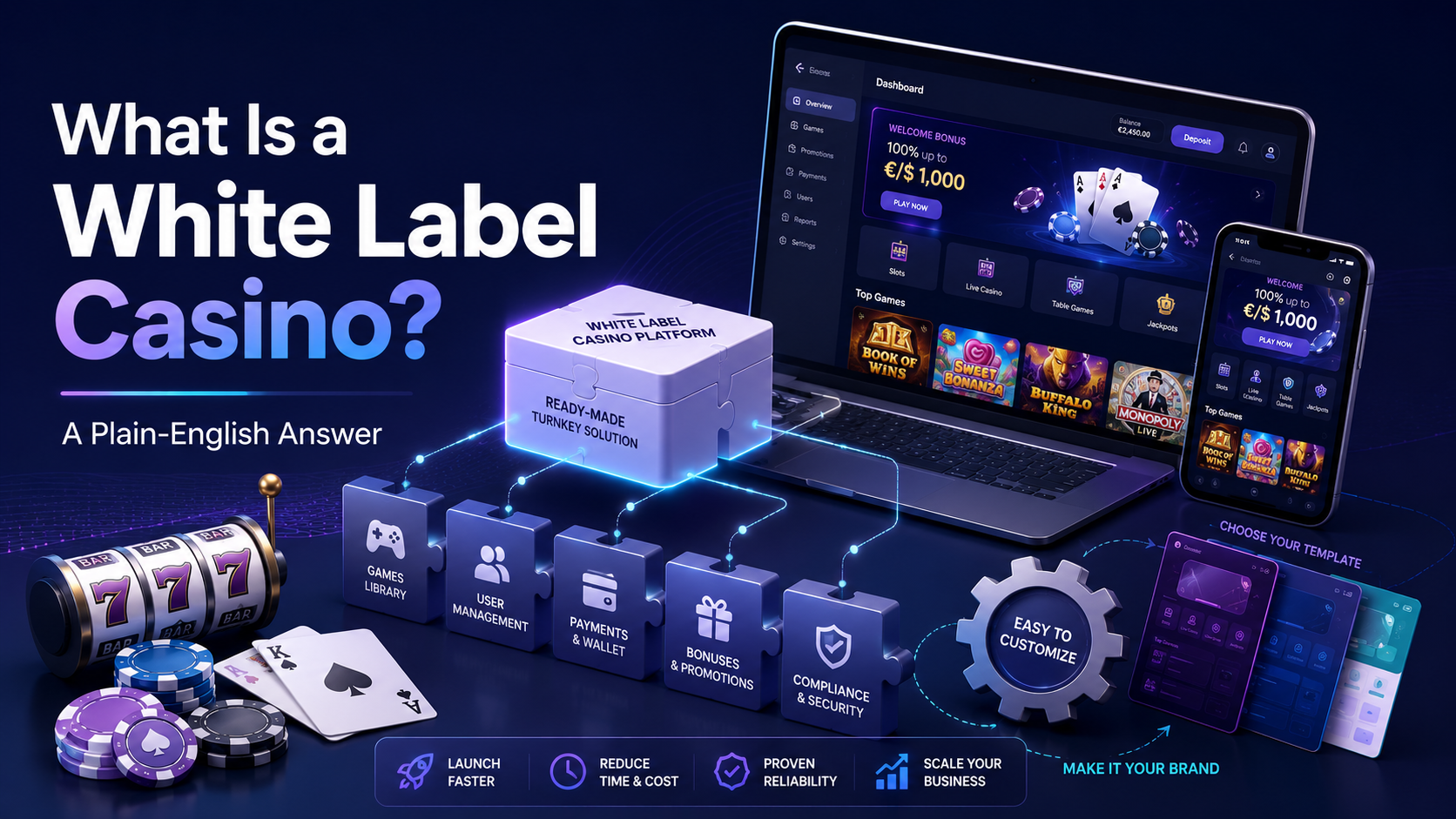
A white label casino is a fully built gambling platform that an operator licenses from a provider, customises with their own branding, and launches as their own product. The underlying software, game integrations, payment infrastructure, and back office tools are built and maintained by the provider. The brand, the marketing, the player relationships, and the day-to-day operation belong to the operator.
That is the simple version. The implications of it — for cost, speed, control, and long-term strategy — are worth unpacking properly.
What You Are Actually Getting
When an operator takes on a white label casino solution, they are not buying code. They are buying a functioning operational system with a blank brand space.
That system typically includes the player-facing platform — the website or app that players register on, browse games through, deposit into, and withdraw from. It includes a game library, usually sourced from multiple providers through an aggregator integration, covering slots, live dealer tables, table games, and increasingly, crash games and fishing titles. It includes payment processing infrastructure, a back office for managing player accounts and transactions, a bonus engine for running promotions, and often an affiliate management system for tracking referral traffic.
All of this exists and works before the operator has done anything. The provider has already built it, tested it, integrated the game content, connected the payment gateways, and configured the back office. The operator’s job is to decide how it looks, what it is called, which games to feature, how to structure their promotions, and how to bring players to it.
What gets applied on top — the brand name, the colour scheme, the logo, the domain, the marketing tone — is the “white label” part. The infrastructure underneath is shared across multiple operators using the same provider’s platform, each running their own distinct brand.
How It Differs from Building from Scratch
Building an online casino from scratch is a legitimate option. It is also a multi-year, multi-million dollar undertaking that most new operators are not positioned to execute.
A custom build requires a development team with iGaming-specific experience, direct integrations with game providers and payment processors, a compliance and licensing strategy that covers every market the casino will operate in, and the time to build, test, and iterate on every component before a single player deposits. The companies that have done this successfully tend to be either well-capitalised businesses with iGaming industry veterans at the helm, or existing operators who have scaled to the point where custom infrastructure delivers a competitive advantage worth the investment.
For everyone else — entrepreneurs entering the iGaming market for the first time, existing businesses in adjacent industries looking to add a gambling vertical, operators who want to test a new market without committing years of development time — a white label solution is the practical alternative.
The difference in time to market is significant. A custom build typically takes anywhere from one to two years before a production-ready platform is live. A white label casino can be configured, branded, and launched in a matter of weeks. TT Wonders is built around exactly this promise — reducing the path from decision to live platform to something measured in weeks rather than years.
The Cost Structure
Custom casino development costs vary widely, but the lower end of realistic estimates starts around $500,000 and climbs quickly when game licensing, payment processor setup, compliance infrastructure, and ongoing development are factored in. For a genuinely competitive product, mid-seven-figures is not unusual.
White label solutions have a different cost model. There is typically an upfront setup fee covering platform configuration, branding integration, and onboarding. There is usually a monthly licensing or revenue-share arrangement with the provider — a percentage of GGR, a flat monthly fee, or some combination. The total cost is considerably lower than a custom build, and critically, it is spread over time rather than required upfront.
This changes the financial profile of entering the iGaming market substantially. The barrier to entry is lower, the initial capital requirement is manageable for a wider range of operators, and the ongoing cost is tied to revenue performance rather than fixed regardless of how the platform performs.
The trade-off is margin. A revenue-share arrangement with a white label provider means a portion of GGR goes to the platform rather than the operator permanently. Over a long enough timeline and at a large enough scale, this may make a custom build financially attractive. For operators in the early stages of building a player base, it is an entirely reasonable cost for the infrastructure, support, and speed-to-market the white label provides. If you want a detailed breakdown of what each model costs and where the trade-offs sit, this comparison between white label and custom builds lays it out clearly.
What Operators Can and Cannot Control
This is the question most new operators ask eventually, and it deserves a straight answer.
On a white label platform, operators typically have full control over their brand presentation — name, visual identity, domain, marketing, and the tone of how they communicate with players. They control their promotional structure: what bonuses to offer, at what terms, to which player segments. They control their game lobby — which titles to feature, how to organise categories, which providers to prioritise. And they control their player relationships — how they communicate, how they handle service, how they run their VIP programme.
What they do not control is the underlying platform infrastructure. Software updates, payment gateway integrations, back office architecture, and game aggregator relationships are managed by the provider. If the provider’s infrastructure has a problem, the operator is affected. If the provider decides to change a feature, the operator does not have unilateral veto power over that decision.
For most operators at the early and mid stages of building a casino business, this trade-off is acceptable. The infrastructure is maintained by people whose entire business is maintaining it well. The operator can focus on what actually differentiates their brand — player acquisition, community, promotion, and experience — rather than managing server infrastructure and payment gateway APIs.
For operators who have reached significant scale and have specific requirements that a shared platform cannot accommodate, the move toward a custom or semi-custom solution becomes worth evaluating. That is a later-stage decision, made from a position of strength rather than necessity.
Licensing: Who Owns It?
This varies by provider and arrangement, and it is one of the most important things to clarify before signing anything.
In some white label arrangements, the provider holds the gambling licence and the operator runs under it. This is the fastest path to market — the operator does not need to apply for their own licence, which removes months from the timeline and a significant cost from the budget. The trade-off is that the operator is dependent on the provider’s licence, meaning the provider’s compliance standing affects the operator’s ability to trade.
In other arrangements, the operator applies for and holds their own licence, with the white label platform sitting underneath it. This takes longer and costs more upfront, but gives the operator full independence. Their licence is theirs. If they ever want to switch platforms, they can take it with them.
Understanding which model a provider offers — and which model suits your risk appetite and long-term plans — is a foundational part of evaluating any white label iGaming solution. The licensing structure is not a footnote. It is one of the most consequential things in the entire agreement.
The Back Office Behind the Brand
One aspect of white label casinos that does not get discussed enough is the back office — the operational layer that the player never sees but the operator lives in every day.
A good white label back office gives operators visibility over everything that matters: player account management, transaction history, bonus redemption tracking, game performance by title and provider, withdrawal queues, and financial reporting. It is where decisions get made and where problems get spotted. Understanding what a fully featured back office looks like — and making sure the white label provider’s back office delivers it — is as important as the front-end design.
Operators who treat the back office as an afterthought when evaluating providers tend to discover its importance at the worst possible time — when a payment issue needs investigating at 2am, or when a player dispute requires reconstructing a session timeline from incomplete data.
Who White Label Is Actually For
The honest answer is that white label suits a specific operator profile well and suits others less.
It is well suited for operators who want to enter the iGaming market without the capital or timeline requirements of a custom build, who have a clear target market and player acquisition strategy, and who are comfortable operating within the boundaries of a shared platform while they build their brand and player base.
It is less suited for operators who need highly specific technical customisation that a shared platform cannot accommodate, who are building in a market where the platform provider has no existing presence or game content relevant to that market, or who are at a scale where the revenue-share cost outweighs the benefit of outsourced infrastructure.
Most operators start in the first category. Some eventually move toward more custom solutions as they grow. That progression is normal — the white label is not a permanent ceiling. It is a starting point that lets the business focus on what actually matters in the early stages: acquiring players, building a brand, and learning the market before committing to infrastructure decisions that are expensive to reverse.
The Part Nobody Explains Clearly
White label casino solutions are well understood inside the industry and persistently misunderstood outside it. The confusion usually comes from the assumption that licensing someone else’s platform means the brand built on top of it is somehow less competitive than one built from scratch.
That assumption gets the comparison wrong. Players do not experience the back end. They experience the front end — the game selection, the registration flow, the withdrawal speed, the customer service, the bonus offer in their inbox on a Tuesday afternoon. These are the things that differentiate one casino from another in the player’s mind. All of them are within the operator’s control on a white label platform.
A well-run white label casino with sharp acquisition, smart promotion, and a game lobby built for its specific market will outperform a poorly run custom build every time. The infrastructure is a vehicle. Where you take it is the actual business.
For anyone seriously considering entering the online casino space, that is the most important thing to understand about the white label model — and the best possible starting point for everything that comes after.
Recommended
 What Is RTP (Return to Player) in Gambling? A Complete Guide for Online Casino Software
What Is RTP (Return to Player) in Gambling? A Complete Guide for Online Casino Software
 What’s Included in a White Label iGaming Solution?
What’s Included in a White Label iGaming Solution?
 Thai Lotto Trends 2024: What’s Driving the Popularity of Lucky Numbers?


