

Every few years, a new game format arrives in online casinos and generates the kind of excitement that makes operators wonder whether they are looking at the next big vertical or a novelty that will fade once the initial curiosity wears off. Live dealer baccarat was once the new format. Mobile slots were once the new format. Fishing games spent years being dismissed as an Asian quirk before operators outside the region started paying attention to the engagement numbers.
Crash games are now at that inflection point — particularly in Asian markets, where adoption has been fastest and player engagement metrics have been strongest. The question operators are asking is the right one: is this a format worth building into the core of a casino lobby, or a trend to ride carefully and not overcommit to?
The answer requires looking at what crash games actually are, why they work for the specific player psychology that dominates Asian casino demographics, and what the data from markets where they have been running the longest is starting to show.
What Crash Games Actually Are
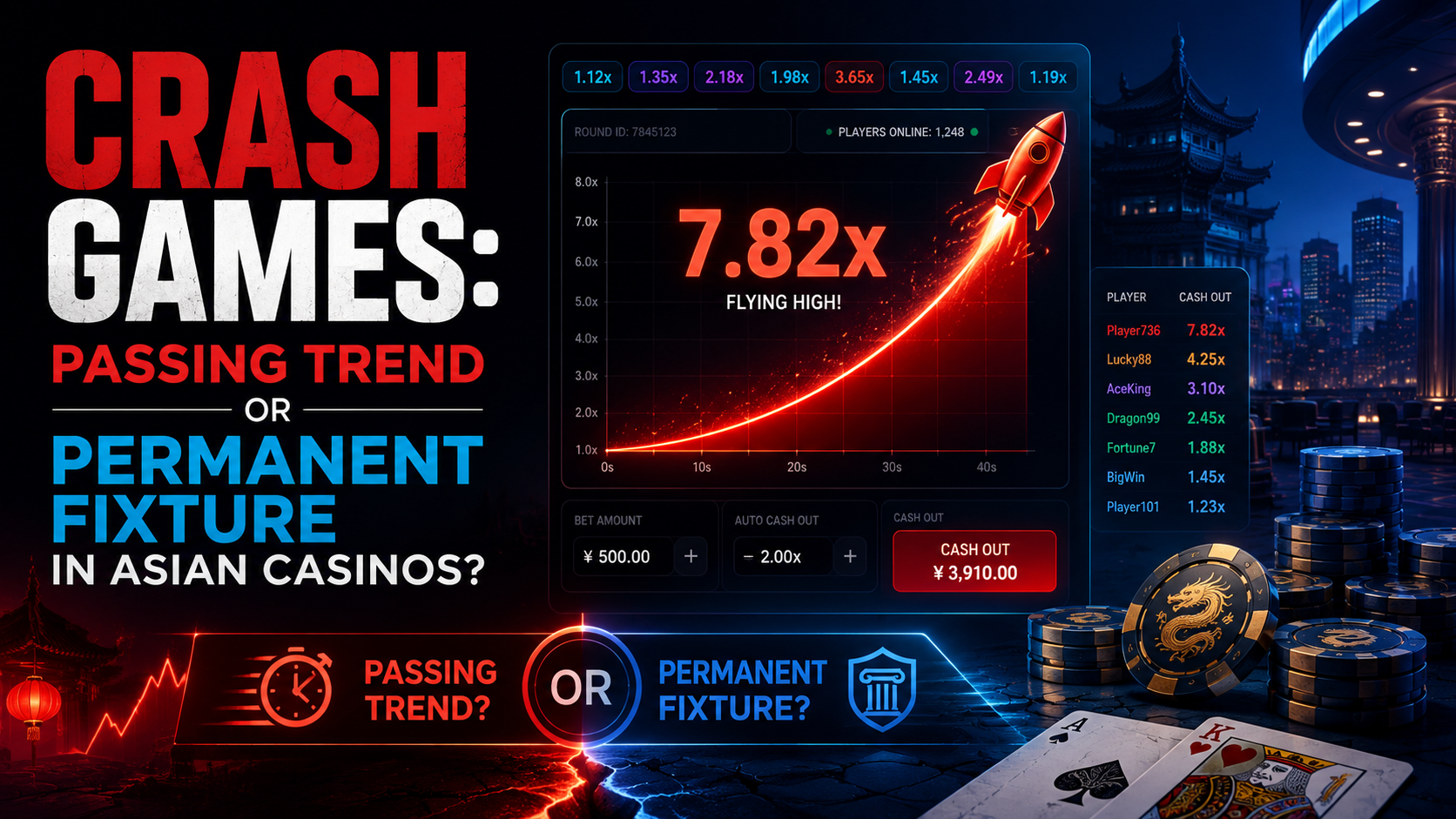
The format is deceptively simple. A multiplier starts at 1x and climbs — slowly at first, then faster, with no predictable ceiling. The player placed a bet before the round began. At any point before the game “crashes,” they can cash out and receive their bet multiplied by the current multiplier. If the game crashes before they cash out, they lose their stake.
That is the entire mechanic. No reels. No cards. No symbols to match. Just a climbing number and a decision about when to leave.
The simplicity is not a limitation — it is the point. The tension in a crash game is immediate and visceral in a way that most casino formats are not. Every second of watching a multiplier climb is a micro-decision: cash out now and take the 2.4x, or hold for 5x, or hold for 10x, knowing the game could crash at any moment. The risk is visible. The reward is visible. The decision is entirely yours.
This active decision-making structure is what separates crash games from slots in the player’s experience. A slot player presses spin and watches an outcome. A crash game player is engaged continuously from the moment the round begins until the moment they cash out or lose. The cognitive experience is closer to trading than gambling in the traditional sense — which is not an accident. Several of the most popular crash game titles draw explicitly on financial market aesthetics: rising charts, price-ticker displays, the visual language of a stock that might spike or collapse without warning.
Why Asian Markets Took to It First
Crash games did not originate in Asia, but they found their most receptive early audience there — particularly in markets like South Korea, Vietnam, Bangladesh, and increasingly Malaysia and the Philippines. Understanding why helps explain whether the format has structural staying power or whether it was riding a wave of novelty.
The first factor is mobile infrastructure. Crash games are inherently suited to mobile play. The entire game fits on a single screen. The interaction is a single button tap. Sessions can last thirty seconds or thirty minutes depending on the player’s preference. In markets where the majority of casino sessions happen on smartphones — which describes most of Southeast and East Asia — a format that works perfectly on a 6-inch screen and requires minimal interface complexity has a structural advantage over formats that were originally designed for desktop play.
The second factor is the cultural resonance of active participation. In many Asian gaming contexts, there is a strong preference for formats where skill or judgment — or at least the perception of it — plays a role. Crash games deliver this feeling even though the outcome is governed by a provably fair RNG. The decision of when to cash out feels meaningful. Players develop personal strategies, talk about them in communities, share screenshots of big cash-outs. The social dimension of the format feeds naturally into the platform communities that have always been important in Asian online gambling markets.
The third factor is pace. Crash games are fast. A round takes seconds. Players can complete dozens of rounds in the time a single slot bonus round might take to trigger. For players who want high-frequency engagement rather than slow-burn sessions, the pace is a feature rather than a compromise.
The Numbers That Matter
The case for crash games as a permanent fixture rather than a trend ultimately rests on what the engagement metrics show — and the picture that has emerged from markets where the format has been running for two to three years is genuinely interesting.
Session length on crash games tends to be shorter per-session than on slots, but return visit frequency is higher. Players come back more often because the format is quick and the itch to “try one more round” is strong. The cumulative session time across a week or month is comparable to slot engagement, achieved through many short visits rather than fewer long ones.
Retention figures at the category level tell a similar story. Players who have crash games as part of their regular rotation on a platform churn at lower rates than those who exclusively play slots — partly because the format variety gives them more reasons to visit, and partly because crash game communities develop a social dynamic that slot play rarely creates.
The monetisation pattern is also distinct. Crash games tend to produce more consistent house edge realisation than high-volatility slots, because the mechanic does not create the extreme variance events — a 50,000x win on a bonus round — that can distort GGR in a single session. The house edge is taken gradually across many rounds, which produces more predictable revenue per active player.
None of this proves the format is permanent. But it does suggest that the engagement it drives is structural rather than novelty-dependent. Players who have been playing crash games for two years are still playing them.
The Operators Who Got It Wrong
Not every operator who added crash games to their lobby benefited from them. Several got the approach wrong in ways that are worth understanding.
The most common mistake was positioning. Operators who dropped one crash game into the “other” or “arcade” category and called it done found that nobody played it. Crash games need to be discoverable and contextualised — surfaced prominently, explained briefly for players who have not encountered the format, and ideally paired with a small free round or demo option so players can understand the mechanic before risking real money.
The second mistake was treating all crash game titles as interchangeable. They are not. Different crash games have meaningfully different house edges, different maximum multiplier ceilings, different visual presentations, and different community features. An operator who integrated the first crash game title available without evaluating the specific product ended up with a mediocre experience that did not reflect the format’s potential.
The third mistake — less common but worth mentioning — was overweighting crash games at the expense of the broader lobby. Crash games are a category, not a strategy. They work best as part of a diverse game portfolio that includes strong slot content, live dealer tables, and for Southeast Asian markets specifically, a solid fishing game selection. An operator whose lobby is dominated by crash games at the expense of depth elsewhere has solved a format question without solving the broader engagement question.
Where the Format Is Headed
The crash game market is developing in several directions simultaneously, and the trajectory suggests deepening rather than fading.
Multiplayer crash experiences — where players can see each other’s bets and cash-out decisions in real time — are producing some of the strongest engagement figures in the category. The social layer transforms a solitary betting decision into a shared spectacle. Watching another player hold at 15x while you cashed out at 3x is both frustrating and compelling in equal measure. These shared emotional moments are what create community, and community is what creates platform loyalty.
Live-hosted crash games, where a presenter narrates and reacts to the multiplier in real time, are the logical next step in the format’s evolution. Several studios are already producing these. The combination of crash mechanics with the live dealer production values that Asian players already respond strongly to creates something genuinely new rather than a remix of existing formats.
For game providers — including those building specifically for Asian market tastes — crash games are now treated as a first-tier format rather than an experimental offering. Content pipelines reflect this. New crash titles are being developed with the same resource investment as slot releases, which suggests the industry’s own assessment of the format’s longevity is considerably more optimistic than the “passing trend” framing implies.
The Honest Answer
Crash games are not a passing trend in Asian casino markets. The engagement data from markets where they have had time to mature is too consistent, the format’s structural fit with mobile-first Asian gaming demographics is too strong, and the content investment from major studios is too significant for this to be a format that quietly disappears in two years.
What they are not is a replacement for anything. The operators who are doing best with crash games are the ones who treat the format as a meaningful addition to a strong lobby rather than a substitute for building depth elsewhere. A casino with excellent slot content from providers whose game design speaks to the target market, a live dealer section that covers the titles Asian players actually want, a fishing game category that gets the prominence it deserves, and a well-positioned crash section is building something defensible.
The question is not really whether crash games are permanent. In the markets where they matter most, they already are. The question operators should be asking now is whether their crash game lobby is good enough — properly positioned, properly stocked with the right titles, and supported by a platform infrastructure capable of delivering the fast, reliable experience that this format, more than most, rewards.
A crash game that buffers during a climb is a crash game nobody plays twice.
Recommended
 Live Dealer Software: What It Is and Why It’s Popular
Live Dealer Software: What It Is and Why It’s Popular
 TT Wonders Expands to Bangladesh: Cricket-Focused Gaming and Special Offers for Merchants
TT Wonders Expands to Bangladesh: Cricket-Focused Gaming and Special Offers for Merchants
 White Label Casino Solutions: Unlocking the Benefits and Opportunities


